
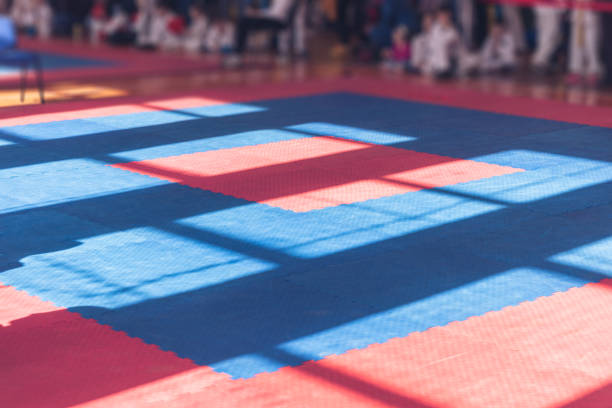
A good throw in judo looks effortless, but anyone who has hit the ground knows how much that illusion costs. The mat beneath makes the difference between safe practice and lasting pain. Judo mats are not decoration; they are part of the discipline itself. They decide how bodies meet the floor and how quickly those bodies get up again.
Each mat has a purpose shaped by years of trial and testing. The ideal one feels firm at first contact yet soft underneath. Too rigid and it bruises joints. Too spongy and it disrupts balance. The right density absorbs force evenly, spreading impact through layers of foam and fabric so that even a powerful throw ends with a clean fall. Athletes learn to trust this invisible partner long before they master technique.
The structure of judo mats seems simple foam core, textured cover but each layer does specific work. The top surface grips bare feet and gi fabric, reducing slips. Beneath that sits a closed-cell foam that compresses under sudden pressure but recovers quickly. Together, they turn impact into controlled deceleration. It’s design that listens to the physics of motion.
Manufacturers obsess over millimetres. Thickness and stiffness determine how a mat behaves when someone lands sideways or headfirst. Good mats use a uniform density from edge to edge, ensuring that one corner doesn’t behave differently from another. That consistency matters; judo relies on repetition, and repetition needs reliability. A surface that surprises an athlete teaches hesitation instead of confidence.
Coaches know that judo mats shape how students move. Beginners fall more often, so the surface must forgive early mistakes. Advanced players throw with power, demanding firmness that won’t bottom out. The best training spaces mix sections of varying hardness, letting students progress safely. In competition halls, mats join seamlessly to create a unified platform with no ridges or gaps every square metre equal, every impact predictable.
Maintenance keeps this quiet safety alive. Foam fatigues, corners lift, vinyl splits at the seams. When that happens, the mat loses its balance between protection and stability. Coaches inspect them daily, checking for uneven wear or damp spots. Replacing panels may seem costly, but neglecting them invites injury. A worn mat remembers every fall too well.
Modern judo mats continue to evolve. New models use anti-slip bases that lock to the floor during throws. Some feature antimicrobial coatings to prevent odour and mould from sweat. A few even incorporate recycled materials, merging sustainability with performance. None of these innovations seek attention they simply refine the partnership between athlete and surface.
Training on the wrong mat changes more than comfort. It alters technique. When the floor feels uncertain, the body hesitates. Throws become cautious, landings stiff. Progress stalls because trust disappears. The right mat, on the other hand, invites commitment. It encourages sharper entries, quicker rolls, smoother recoveries. It becomes part of the learning rhythm.
Instructors often say that a good dojo feels alive. That feeling comes from energy safely absorbed and returned through every square of the floor. The mat breathes with movement, softening impact while preserving intensity. It’s why seasoned practitioners test the surface before training. They press it with their heel, bounce lightly, and nod when it feels right.
The truth is simple: every judo story begins and ends on the mat. It supports ambition, cushions mistakes, and forgives the occasional bad day. The wrong one leaves marks that outlast the session. The right one lets the lesson continue tomorrow. And that quiet difference felt in muscle, not seen by eye is what keeps the art alive, safe, and endlessly repeatable.